Revolut address audit: 1.46M USDT TRC-20 transfers paid by burning TRX
A hotspot address is a company wallet with a constant flow of transfers running through it. Every service working with USDT TRC-20 operates one, and it is where the fee stops being small change and turns into a budget line. This material is an audit of the public Revolut hotspot address TGkHfYXkgUgHjAKcYf3gob2rLd1N7BqRQs, based on Tron Network blockchain data.
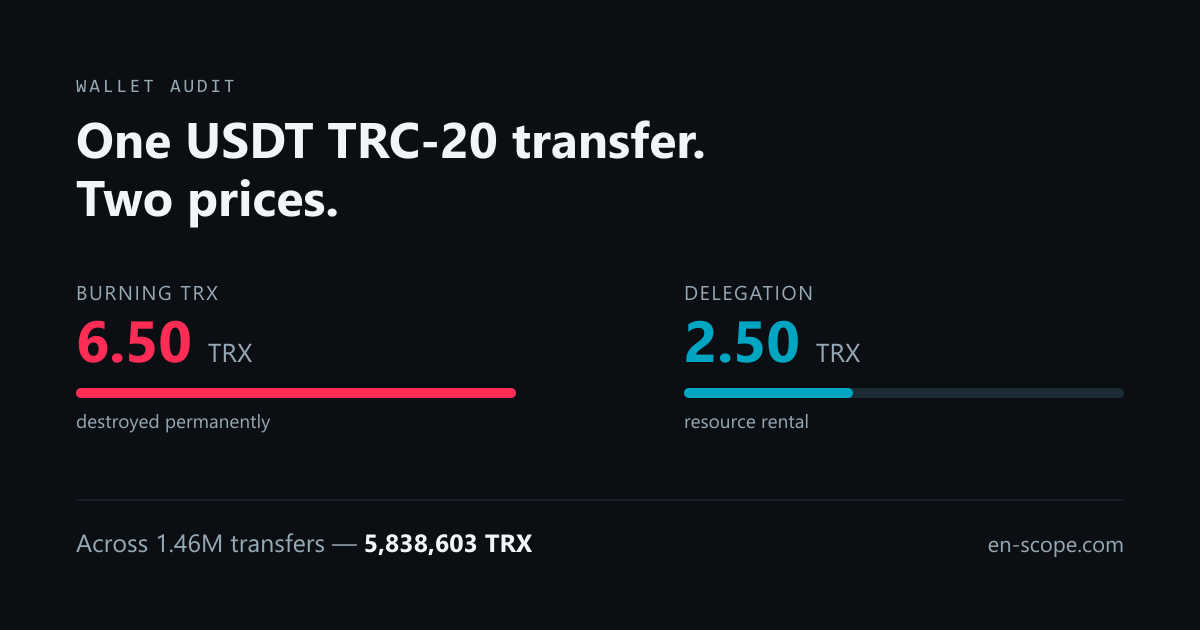
Over one year the address made 1.46 million transfers and paid for them by burning TRX — the method the network offers by default. The same volume through wholesale Energy delegation would have cost 5,838,603 TRX less, roughly $1.87M at the current rate. On 25 October 2025 the address switched to delegation, and the fee bill dropped by a factor of 2.7 at the same transfer volume.
Below is the month-by-month calculation: how many transfers, how much TRX was burned, and what the same volume would cost at the wholesale rate of 2.50 TRX per transfer. Both phases are recorded on-chain and the calculation reproduces from a public export — no wallet access required. All amounts are normalised to the current network price, at 1 TRX = $0.32.
- Transfers during the burn year
- 1,459,651
- TRX burned
- 9,487,730 · $3,036,074
- Cost through delegation
- 3,649,127 TRX · $1,167,721
- Overpaid
- 5,838,603 TRX · $1,868,353
The price of a single transfer
The Tron Network sets this price, not any service: one transfer consumes 65,000 units of Energy, and the network charges 0.0001 TRX for each unit. Burning destroys TRX permanently; delegation burns nothing, because the resource is borrowed for a fixed term.
2.50 TRX for 65,000 Energy is the final price at EnergyScope. There are no hidden fees, no subscription and no volume surcharge: the resource arrives at the address and the transfer goes through without burning TRX for Energy.
- Energy per transfer
- 65,000 Energy
- Network price per Energy unit
- 0.0001 TRX
- Paying by burning
- 6.50 TRX · $2.08
- Paying by delegation (wholesale)
- 2.50 TRX · $0.80
- Difference per transfer
- 4.00 TRX · $1.28
The calculation uses 65,000 Energy. When the recipient holds no USDT, 130,000 Energy is required and the transfer costs twice as much — so the overpayment on burning doubles as well.
What the switch looks like
Bar height is the total Energy consumed that month; colour shows how it was paid for. Hover over a bar or tap it and the figures for that month appear below the chart: transfers, Energy, cost, and the amount that delegation would have saved.
- Burning TRX, 10.10.2024 — 10.10.2025
- 94,877,299,455 Energy (98.4%)
- Delegation, 10.10.2024 — 10.10.2025
- 1,513,322,015 Energy (1.6%)
- Burning TRX, 25.10.2025 — 06.08.2026
- 537,106,997 Energy (0.8%)
- Delegation, 25.10.2025 — 06.08.2026
- 70,365,715,926 Energy (99.2%)
- Peak burn day, 2 December 2024
- 700,859,945 Energy in 24 hours
The burn year
Three hundred and sixty-six days in a row without a single break: about 3,988 transfers a day, 166 an hour. The peak day was 2 December 2024, with 700,859,945 Energy in twenty-four hours.
- Period
- 10.10.2024 — 10.10.2025
- USDT TRC-20 transfers
- 1,459,651
- Burned
- 9,487,730 TRX · $3,036,074
- Cost through delegation
- 3,649,127 TRX · $1,167,721
- Overpaid
- 5,838,603 TRX · $1,868,353
Transfer counts are derived by dividing actual Energy consumption by 65,000. Per day, the overpayment came to roughly $5,105.
What changed after the switch
Since 25 October 2025 burning has stayed at zero and Energy arrives by delegation. The address itself holds 0 staked TRX: the resource is rented from a provider rather than funded by freezing its own capital.
- Period
- 25.10.2025 — 06.08.2026
- USDT TRC-20 transfers
- 1,082,549
- Burning would have cost
- 7,036,572 TRX · $2,251,703
- Paid through delegation
- 2,706,374 TRX · $866,040
- Saved
- 4,330,198 TRX · $1,385,663
Month against month
The clearest comparison is two months with almost identical volume: one on burning, one on delegation.
| Metric | August 2025 | January 2026 |
|---|---|---|
| Payment method | Burning TRX | Delegation |
| Transfers | 150,454 | 146,141 |
| Monthly bill, TRX | 977,954 | 365,353 |
| Monthly bill, USD | $312,945 | $116,913 |
Bandwidth — the second place money leaks
Besides Energy, every USDT TRC-20 transfer consumes about 345 units of Bandwidth. The network grants 600 units a day for free — fewer than two transfers. The rest is paid by burning TRX, roughly 0.345 TRX per transfer.
Across 1.46 million transfers that is another 503,000 TRX or so, about $161,000 a year, on top of the figures above. Bandwidth is delegated exactly like Energy and removes that cost line the same way.
More detail on how Energy differs from Bandwidth and when TRX is charged.
Notes on the calculation
- Energy consumption is taken as actual values from the blockchain export, so transfers to empty addresses at 130,000 Energy and service operations are already inside the figures. Exactly one value is an estimate — the transfer count.
- Until 29 August 2025 the network Energy price was 210 sun rather than today's 100, so the address actually burned around 18.57 million TRX rather than 9.49 million. The calculation is normalised to today's price to keep the comparison against today's rate valid, which makes the overpayment a floor.
- Since 6 July 2026 the volume on the address has dropped roughly twentyfold: the flow is moving to another address. The effect on the totals is small, about 0.5% of the period's volume.
What this gives at your own volume
The calculation reproduces from the TRONSCAN "Energy Consumed" export for address TGkHfYXkgUgHjAKcYf3gob2rLd1N7BqRQs over the periods stated.